A Level retakes for 2026/27 are sat in the May/June 2027 series, with results on 12 August 2027. Standard exam entry closes around 21 February 2027. Board fees about £110 to £170 per subject for most subjects with AQA, Edexcel or OCR; £340 to £450 for the written papers at most private candidate centres. This guide covers the entry deadlines, three routes (school/college/private), private candidate exam centres, UCAS timing, and everything else you need to plan a retake.
Retaking one or more A Levels can lift a whole grade band and open up degree offers that were previously out of reach. This is the 2026/27 practical guide: how the timeline works, the three ways to retake (school, college, or private candidate), what it costs, and how a retake fits alongside a UCAS application.
Everything below is based on the confirmed 2027 exam series timetable and awarding body fees published by AQA, Pearson Edexcel and OCR for 2026/27.
Retaking A Levels online: how it works
You can retake an A Level online with the exam arranged for you. At Lift College you study the same specification sat in UK schools (AQA for ten subjects, WJEC Eduqas for Film Studies) with a named UK tutor who marks your practice, and on the +Exams plan Lift College makes your entry before the awarding body's deadline and books your seat at one of ten Tutors & Exams centres in England, with the entry and centre fees included. On Study (£49.99 a month) you can enter yourself as a private candidate; exam entry is only on +Exams. A Levels are examined once a year in the May/June series, so a retake sat in May/June 2027 means starting now and studying more than the usual 8 to 12 hours a week, because most learners take 12 to 18 months at that pace and finish faster only with more time each week.
Two things matter when you resit. First, match the specification you sat before where you can, because content differs between boards; Lift College's course pages name the exact specification (for example AQA 7357 for Mathematics and AQA 7182 for Psychology). Second, decide who books the exam: our guide to A Level private exam centres covers booking your own, and can you do A Levels online? explains how online study and in-person exams fit together. Every Lift College plan starts with a 7-day free trial, with nothing charged until day 8, no contract, no credit check and a 14-day money-back guarantee on every payment. To compare providers for the subject you are resitting, see best online A Level Mathematics courses and best online A Level Psychology courses; every subject is linked from the A Level hub.
Retake with our online A Level courses : study from home, with your exams arranged for you on +Exams.
How much does an A Level retake cost in 2026/27?
A Level retake costs break down into two parts: the awarding body entry fee and any tuition, materials or centre admin fees. Awarding body fees for summer 2027 are published and confirmed:
Swipe to compare →Scroll sideways to compare →
| Awarding body | Typical entry fee per subject | Example | Notes |
|---|---|---|---|
| AQA | £109.60 to £252.95 | Business £109.60; Design & Technology £252.95 | One-off fee per student, all components included |
| Pearson Edexcel | £119.40 to £256.80 | Fees apply 1 Aug 2026 to 31 Jul 2027 | Published on Pearson centre admin fees page |
| OCR | £139.25 to £219.25 | General qualification fees 2026/27 | Effective 1 Aug 2026 |
A Level retake deadlines for 2027 exams
The key dates for a summer 2027 A Level retake are:
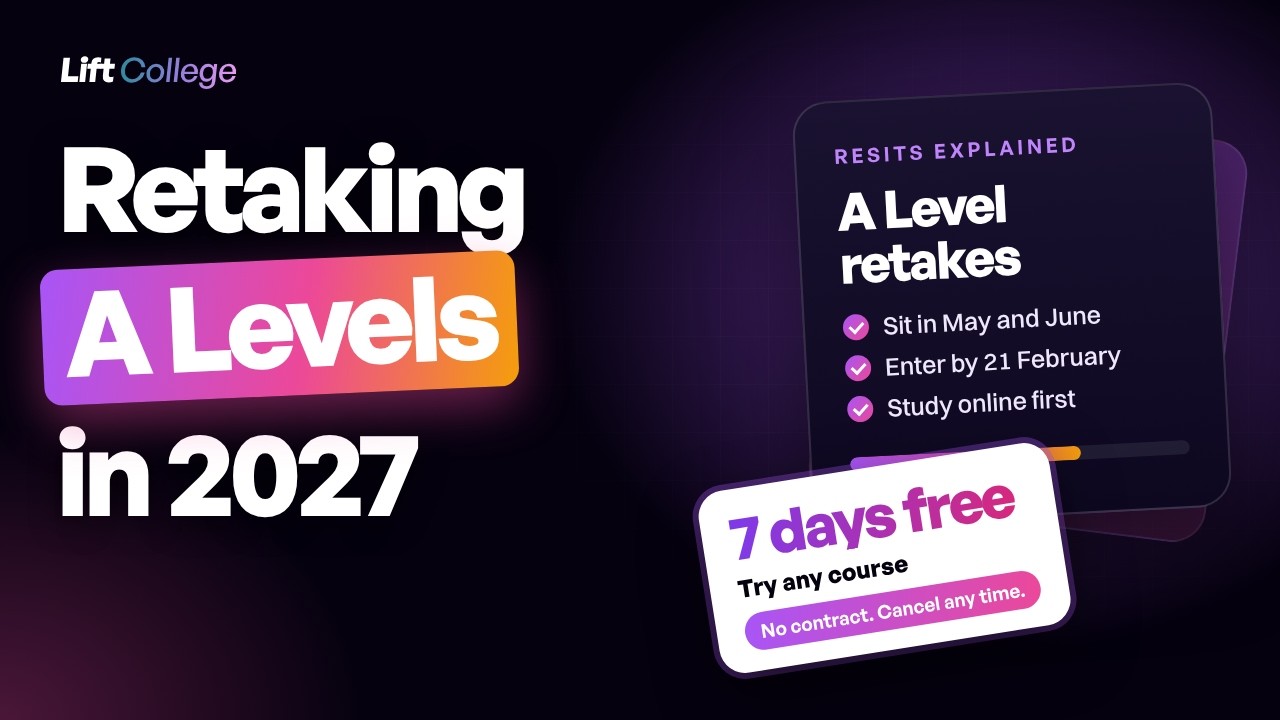
- Around 21 February 2027: standard exam entry deadline (JCQ common date across AQA, Edexcel and OCR).
- From 22 February 2027: late entry at double the standard fee (AQA, OCR, Pearson). From about 22 April 2027: very late entry at 2.5 times (AQA) or 3 times (OCR, Pearson) the fee.
- Late April to late June 2027: A Level exam window.
- Thursday 12 August 2027: A Level results day (AQA confirmed).
If you are working with an exam centre as a private candidate, they will usually want you registered several weeks before the JCQ deadline so they have time to process your entry; check with your chosen centre and book early.
How to retake as a private candidate
A private candidate is someone who is not enrolled at a school or college but sits the exams at a registered exam centre. This is the most flexible route for adults who have left full-time education. The process is:
- 1. Decide which awarding body specification you studied (AQA, Edexcel or OCR; check your old certificate).
- 2. Find a JCQ-approved exam centre that accepts private candidates for that specification. Tutors & Exams and many FE colleges list private candidate services.
- 3. Register with the centre and pay both the awarding body entry fee and the centre administrative fee.
- 4. Prepare for the exams: self-study, online course, or private tutor. Most private candidates use a combination.
- 5. Sit the exams in the standard May/June exam window and collect results on 12 August 2027.
Retakes and UCAS: how to time it
The UCAS application cycle runs from September to late January (equal-consideration deadline is 29 January 2027 for 2027 entry). This creates two options for retake candidates:
- Apply during your retake year for 2027 entry: you will hold conditional offers dependent on your August 2027 results.
- Take a gap year, retake, then apply in autumn 2027 for 2028 entry with your improved grades in hand.
Applying with retake grades already in hand is often the stronger strategy for competitive courses: you avoid the uncertainty of conditional offers, and admissions tutors see a completed retake as evidence of resilience.
Your three retake routes compared
Swipe to compare →Scroll sideways to compare →
| Route | Typical cost | Timeline | Best for |
|---|---|---|---|
| Sixth form college | Free if under 19; £3,000-£6,000 if over 19 | 1 year full-time | Recent school leavers who want classroom teaching |
| Private online course | From £49.99 a month at Lift College on Study, with exam entry and centre fees on the +Exams plan; fixed fee providers typically £395 to £730 per subject with exam fees extra (checked 11 October 2026) | 12 to 18 months at 8 to 12 hours a week, or faster with more time; flexible | Adults balancing retakes with work or family |
| Private candidate (self-study) | £340 to £450 per subject (exam and centre fees) | 3-12 months, fully self-directed | Strong self-directed learners on a budget |
Should you retake?
A retake is worth serious consideration if your grades fell one band below what you needed (BBB when you needed AAB, for example) and you are confident you can lift them with focused work. It is a less obvious choice if your grades were already at the ceiling of what practice and mocks suggested, in which case an Access to HE route to the same degree may be a faster path.
Whichever route you pick, treat the retake year as a proper study year. Retakes fail most often when candidates underestimate how much content needs re-covering and how tightly the timetable moves between February entry and June exams.
Your next step
Start the A Level Mathematics course free for 7 days
AQA, Ofqual regulated · From £49.99/month · £0 today. Nothing is charged until day 8.