
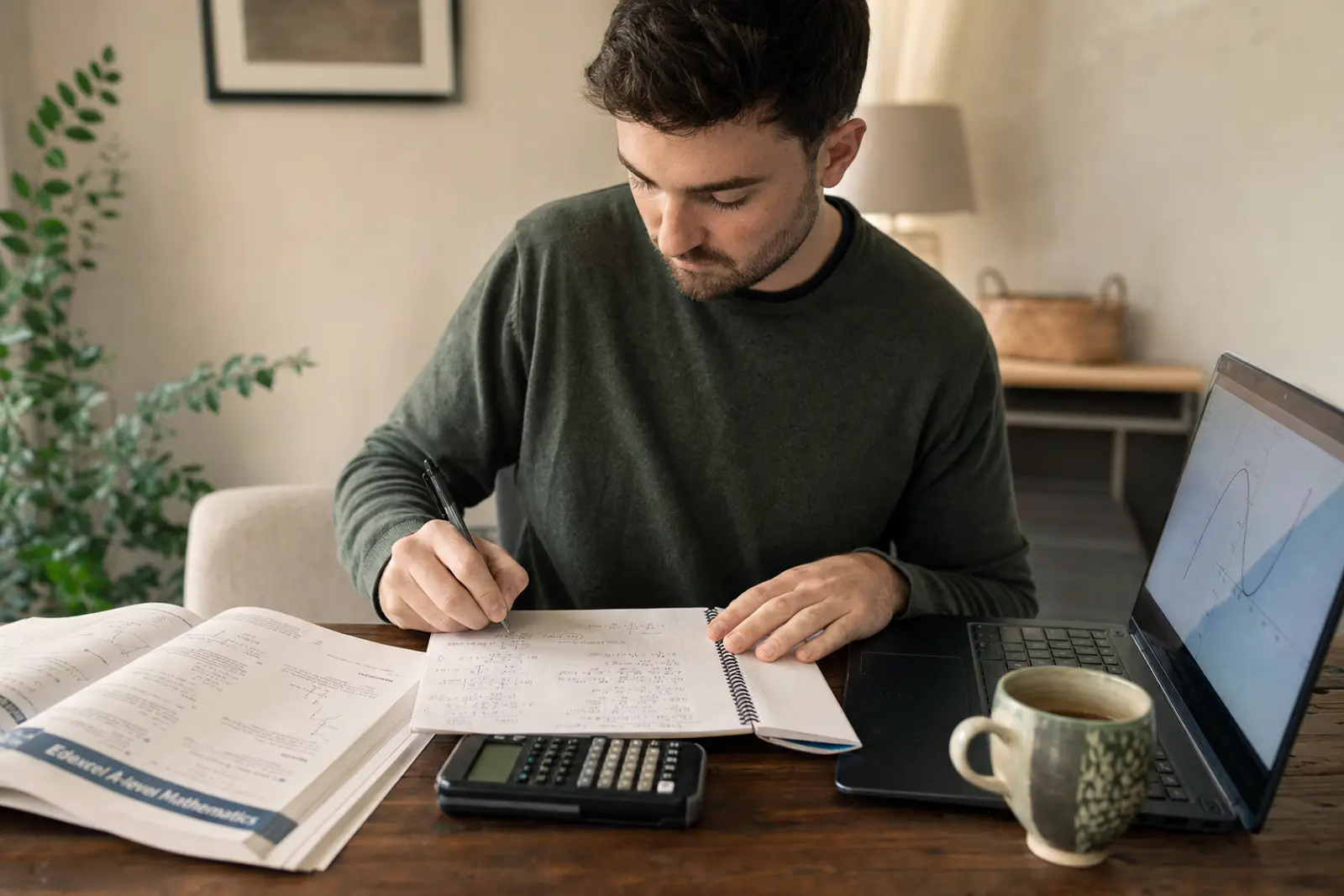
Editor's note (14 September 2026): Lift College delivers online A-level Mathematics through AQA (specification 7357), not through Pearson Edexcel. This article explains the Edexcel 9MA0 specification for general reference. If you are looking for the course Lift College teaches, see our A-level Mathematics course page.
Edexcel A-level Mathematics (Pearson Edexcel, specification code 9MA0) is a two-year linear qualification assessed entirely by three written examinations at the end of Year 2. It covers Pure Mathematics, Statistics and Mechanics, and is graded A* to E. A-level grades carry standard UCAS tariff points (A* = 56, A = 48, B = 40, C = 32, D = 24, E = 16) and the qualification is widely accepted for university entry, including for STEM, economics and finance degrees.
Our online A-level Maths course follows the Edexcel specification exactly.
What is Edexcel A-Level Maths?
Edexcel A-level Mathematics, formally awarded by Pearson Edexcel under specification 9MA0, is one of the most widely sat A-level subjects in England, Wales and Northern Ireland. It develops rigorous mathematical reasoning across three core content areas: Pure Mathematics, Statistics and Mechanics.
The qualification is linear, meaning all examinations are sat at the end of the full two-year course rather than in modular sittings, and every paper is sat with the Edexcel A-level Maths formula sheet printed inside the answer booklet. This structure has been in place since the 2017 reforms introduced by Ofqual and the Department for Education, and it applies to all students sitting the qualification from 2019 onwards.
Edexcel (Pearson) is one of the three major awarding bodies offering A-level Mathematics in the UK, alongside AQA and OCR, and our guide to the UK exam boards explains how each board differs in paper style and adoption. All three awarding bodies deliver the same nationally mandated content set by the Department for Education; the main differences lie in paper style, question wording and the choice of large data set.
9MA0 specification at a glance
Pearson Edexcel A-Level Mathematics is coded 9MA0. The full A-Level is assessed by three externally examined papers sat at the end of the two-year course. Each paper is 2 hours long and carries 100 marks (300 marks total).
Swipe to compare →Scroll sideways to compare →
| Paper | Topics | Duration / Marks | Calculator |
|---|---|---|---|
| Paper 1 (9MA0/01) | Pure Mathematics 1 | 2 hours / 100 marks | Allowed |
| Paper 2 (9MA0/02) | Pure Mathematics 2 | 2 hours / 100 marks | Allowed |
| Paper 3 (9MA0/03) | Statistics and Mechanics | 2 hours / 100 marks | Allowed |
Grading is A* to E across the full qualification (there is no AS carry-over into the A-Level grade). See the official Pearson 9MA0 specification for the full content breakdown, assessment objectives and grade boundary methodology.
What topics are covered in Edexcel A-Level Maths?
The Edexcel 9MA0 specification is divided into two broad strands: Pure Mathematics (the largest component) and Applied Mathematics (split between Statistics and Mechanics).
Pure Mathematics
- Algebra and functions
- Coordinate geometry in the (x, y) plane
- Sequences and series (including binomial expansion)
- Trigonometry
- Exponentials and logarithms
- Differentiation and integration (calculus)
- Numerical methods
- Vectors
Statistics
- Statistical sampling
- Data presentation and interpretation
- Probability
- Statistical distributions (including binomial and Normal distributions)
- Hypothesis testing
Mechanics
- Quantities and units in mechanics
- Kinematics (motion in a straight line and in two dimensions)
- Forces and Newton's laws
- Moments
Note on the large data set: Edexcel requires students to be familiar with a pre-released large data set (LDS) relating to weather data. Questions in the Statistics papers may reference this data set, so familiarity with it is an assessed expectation, not optional preparation.
How is Edexcel A-Level Maths assessed?
Edexcel A-level Maths (9MA0) is assessed through three written examinations, all sat at the end of the course. There is no coursework component. Paper 1 (Pure Mathematics 1) is 2 hours and 100 marks, covering pure content. Paper 2 (Pure Mathematics 2) is 2 hours and 100 marks, also on pure content. Paper 3 (Statistics and Mechanics) is 2 hours and 100 marks, with Section A on Statistics and Section B on Mechanics. Total: 300 marks across 6 hours of examination.
All three papers allow the use of a calculator. Pearson publishes a list of permitted calculator models; students should confirm their calculator is on the approved list before their examination series.
Examinations are sat at an approved examination centre. Students studying online arrange to sit their papers at a registered centre near them.
What grade boundaries and grading system apply?
Edexcel A-level Maths is graded on the standard A-level scale: A*, A, B, C, D, E (with U for ungraded). The A* grade is awarded to students who achieve an A overall and score 90% or above across Papers 1 and 2 combined (the Pure papers).
Grade boundaries vary each examination series and are published by Pearson Edexcel after results are released. They are not fixed percentages; they reflect the difficulty of that year's papers and the performance of the cohort. You can find historical grade boundaries on the Pearson Edexcel website.
What are the entry requirements for Edexcel A-Level Maths?
Typical academic entry requirements
Most traditional providers recommend that students have achieved at least a Grade 6 or 7 in GCSE Mathematics (or an equivalent qualification) before beginning A-level Maths. A strong GCSE grade indicates the algebraic fluency and problem-solving confidence that A-level content demands from the outset.
Most providers recommend that students have achieved at least a Grade 6 or 7 in GCSE Mathematics (or an equivalent Level 2 mathematics qualification) before starting the course. A-level Maths builds directly on the algebraic, trigonometric and statistical foundations laid at GCSE.
Is there a minimum age requirement?
A-level courses are typically available to students aged 16 and over. Adult learners, A-level resitters and home-educated students of all ages regularly sit A-level Maths.
Do I need any other A-levels alongside Maths?
There is no formal requirement to study specific subjects alongside A-level Maths, but students aiming for mathematics, engineering, physics or economics degrees at competitive universities often study Further Maths (A Level Further Maths explained), Physics or Chemistry alongside it. Check individual university entry requirements for your chosen degree.
How long does Edexcel A-Level Maths take to complete?
A-level Maths is conventionally a two-year course, typically studied over Years 12 and 13 in a school or college setting. Online study offers greater flexibility, with standard pace approximately 18 to 24 months and accelerated study allowing some students to complete the content in 12 to 18 months.
Most self-paced online learners complete the course in 9 to 18 months, subject to exam series availability. Because the qualification is linear, all examinations are sat in a single examination series (typically May/June). Students who begin in autumn have the option of sitting exams the following May/June if they are ready.
Can I study Edexcel A-Level Maths online?
Yes. Edexcel A-level Mathematics can be studied online through providers that offer the Pearson Edexcel 9MA0 specification, allowing you to study at your own pace from anywhere in the UK. Online A-level Maths suits adult learners returning to education or changing career direction, A-level resitters who need to improve a grade for university, home-educated students, and career changers moving into STEM roles.
Online study does not change the qualification itself; you sit the same Edexcel 9MA0 papers as any other candidate, at an approved examination centre, and receive the same Pearson Edexcel certificate.
What can Edexcel A-Level Maths lead to?
University and higher education
A-level Maths is a required or strongly recommended entry requirement for a wide range of degree programmes, including Mathematics and Further Mathematics, Physics and Engineering (civil, mechanical, electrical, aerospace), Computer Science, Economics and Econometrics, Actuarial Science and Finance, Architecture (some programmes), and Psychology (some programmes, particularly those with quantitative methods).
Many Russell Group universities specify A-level Maths as a required subject rather than a preferred one for STEM courses. Always check the specific entry requirements of your chosen institution and course.
UCAS tariff points
A-level grades carry standard UCAS tariff points: A* = 56, A = 48, B = 40, C = 32, D = 24, E = 16. The standard tariff applies to all Edexcel A-level qualifications.
Careers
Mathematical literacy at A-level standard supports careers in data science, software engineering, finance, teaching, research and many other fields where quantitative reasoning is valued.
Edexcel A-Level Maths: Key Facts at a Glance
Qualification title: A-level Mathematics. Awarding body: Pearson Edexcel. Specification code: 9MA0. Grading scale: A* to E (U = ungraded). Assessment method: 3 × 2-hour written exams (no coursework). Total marks: 300. Core content areas: Pure Mathematics, Statistics, Mechanics. Large data set required: Yes (Statistics component). Typical study duration: 18 to 24 months (flexible online). Exams sat at: approved examination centre. Recommended GCSE entry: grade 6 or 7 in GCSE Maths. UCAS points: A* = 56, A = 48, B = 40, C = 32, D = 24, E = 16.
For current course fees, see our A-level courses page. Exam centre fees are typically charged separately by the centre you register with.
Frequently Asked Questions
Is Edexcel A-Level Maths harder than AQA or OCR?
The three major A-level Maths specifications, Edexcel (9MA0), AQA (7357) and OCR A (H240), cover the same nationally mandated content set by the Department for Education. All boards must include the same Pure, Statistics and Mechanics content. Differences lie in paper style, question phrasing and the specific large data set used. No specification is officially classified as harder than another; the right board for you depends on your learning style and the resources available to you.
Does Edexcel A-Level Maths include Further Maths?
No. A-level Mathematics (9MA0) and A-level Further Mathematics (9FM0) are separate qualifications. Further Maths extends and deepens the content of A-level Maths and is typically studied alongside it by students aiming for highly mathematical degree programmes.
Can I resit Edexcel A-Level Maths as an adult?
Yes. There is no upper age limit for sitting A-level examinations. Adult learners and resitters make up a significant part of A-level cohorts nationally. You sit the same papers as school-age students and receive the same Pearson Edexcel certificate.
Do I need a graphical calculator for Edexcel A-Level Maths?
A scientific calculator is required for all three papers. A graphical calculator is permitted but not required. Pearson publishes a list of approved calculators; students should verify their model is permitted. Calculators with CAS (computer algebra system) functionality are not permitted.
When are Edexcel A-Level Maths exams sat?
Edexcel A-level Maths examinations are typically held in May and June of each year. The exact timetable is published by Pearson Edexcel and JCQ (Joint Council for Qualifications) in advance of each series.
How do I find an exam centre as an online student?
As a private candidate studying online, you will need to register with an approved examination centre to sit your Edexcel papers. Many centres charge an invigilation or entry fee in addition to any course fee.
What is the Edexcel large data set and how do I prepare for it?
The Edexcel large data set (LDS) is a pre-released spreadsheet of real weather data from weather stations in the UK and overseas. Questions in Paper 3 (Statistics) may refer to this data. Preparation involves becoming familiar with the structure, variables and patterns in the data set, not memorising every figure. Pearson releases the LDS ahead of the examination series so students can study it.
Is A-level Maths worth doing if I am not going to study Maths at university?
Yes, for many students. A-level Maths is one of the most highly regarded A-level subjects by universities and employers across a wide range of fields. It demonstrates analytical thinking, problem-solving and quantitative reasoning, skills valued in economics, computing, sciences, finance and beyond. Even if your degree is not mathematics-specific, an A-level in Maths can strengthen your application and broaden your options.
How much does Edexcel A-Level Maths cost?
Course fees vary by provider. Exam centre fees are typically charged separately by the centre you register with, and vary depending on the centre and the number of papers being sat.
Looking for A-level Mathematics at Lift College? Lift College delivers A-level Maths online through AQA (specification 7357). Visit our A-level Mathematics course page for details, or contact our advisors to find out more.