
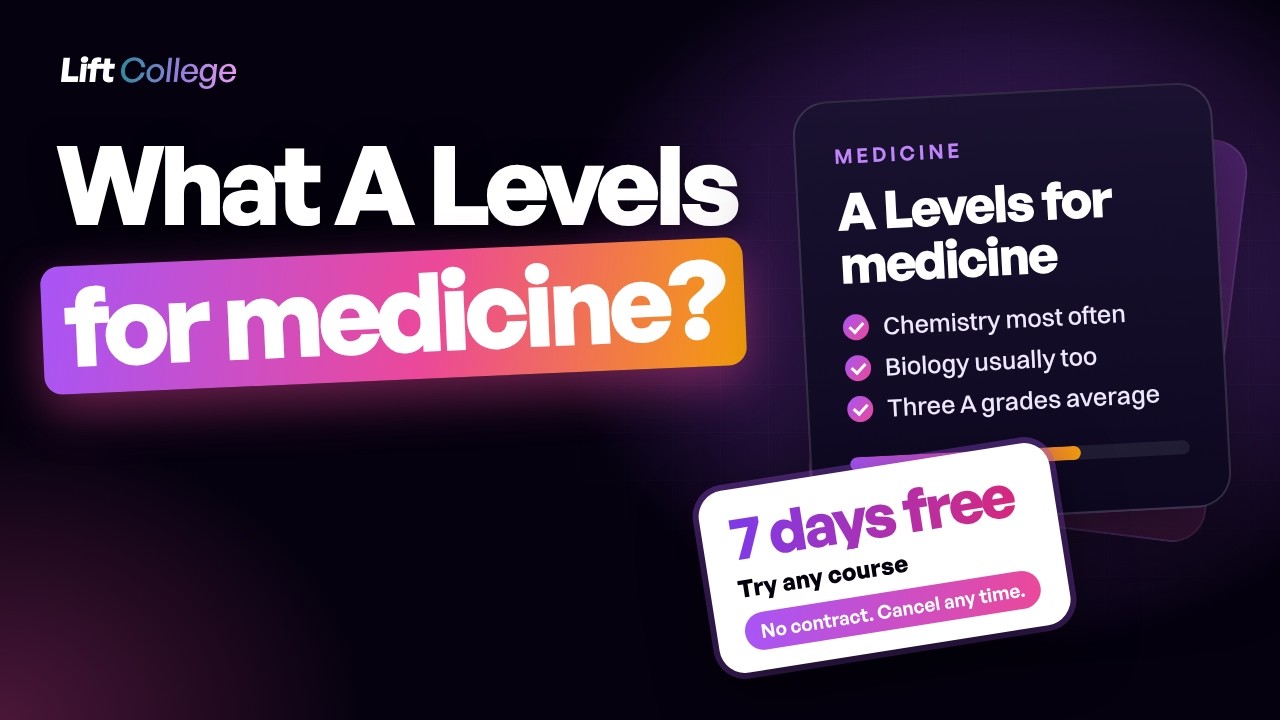
For medicine in the UK you usually need three A Levels at high grades, most often including Chemistry and Biology, but each medical school sets its own subjects and grades, so check each school. The Medical Schools Council's guidance says "Chemistry and Biology A levels are the most common requirements" and that at least two A Levels are usually named by each school; UCAS gives AAA as the average A Level requirement for medicine, and some schools ask for A*AA (King's College London lists A*AA for September 2027 entry). Some schools may also require a pass in the science practical endorsement, and many expect your A Levels to have been taken in one sitting. If you are an adult studying from home, Lift College teaches A Level Chemistry (AQA 7405) and A Level Biology (AQA 7402) online from £49.99 a month on Study when you pay today (£59.99 after a 7-day free trial), with exam entry at a Tutors & Exams centre on the +Exams plan and the CPAC practical endorsement on +Exams & CPAC, all with no contract.
The subjects medical schools ask for
Every medical school publishes its own requirements, and the Medical Schools Council (MSC) course search for entry in autumn 2027 lets you filter courses by "Chemistry A level required" or "Chemistry A level not compulsory", with the note that "Information is provided directly by medical schools but may change, so always verify on their websites". The pattern across schools, as the MSC's entry requirements guidance describes it:
- Chemistry is the subject most often required. Where a school lists "Chemistry A level not compulsory", read its page to see which science subjects it asks for instead.
- Biology is the other most common requirement, and the natural pair with Chemistry.
- A third subject is your choice at most schools. Mathematics or Physics keeps every option open; some schools exclude particular subjects (the MSC gives Further Mathematics as an example of a subject some schools do not count), so check before relying on it.
- Grades: UCAS lists AAA as the average requirement. Offers vary from AAA to A*AA; read the school's own page for the cycle you are applying in.
Treat the MSC course finder as the starting point and the school's own page as the final word. Requirements for 2027 and 2028 entry can differ from the previous cycle.
Practicals, resits and one sitting
Three rules catch adults out:
- The practical endorsement. The MSC notes that some schools may also require a pass in the A Level science practical. The endorsement (CPAC) is reported separately from your grade in Biology, Chemistry and Physics. At Lift College it is included on +Exams & CPAC and assessed at a Tutors & Exams laboratory venue against the Common Practical Assessment Criteria, reported separately as a Pass on your certificate. If you are aiming at medicine, choose the plan that includes it.
- One sitting. The MSC guidance says "Many medical schools will expect you to have taken your exams in one sitting". If you are resitting, or spreading subjects over more than one year, check each school's policy on resits and on A Levels taken in different series before you commit. Our retaking A Levels guide covers the mechanics.
- Access to Medicine courses. Some medical schools accept Access to Medicine qualifications, but the MSC is clear this is not a route for applicants who have "simply underachieved" at A Level; schools tend to favour applicants who have not previously taken post 16 qualifications or who have substantial life or work experience. Check eligibility with the school before you start an Access course.
Planning the three A Levels as an adult
If you have no science A Levels, the usual plan is Chemistry and Biology plus Mathematics or Physics, taken together and sat in the same May/June series so they count as one sitting. Medical schools also screen on GCSEs, so check the GCSEs you need to become a doctor before you plan the A Levels. Lift College teaches all four online: Chemistry (AQA 7405, three papers of 2 hours), Biology (AQA 7402, three papers of 2 hours), Mathematics (AQA 7357, three papers of 2 hours) and Physics (AQA 7408, three papers of 2 hours). Each is the same qualification sat in schools, with the same AQA certificate. The recommended starting point for Chemistry is GCSE Chemistry or Combined Science at grade 6 or above and GCSE Mathematics at grade 5 or above, because at least 20% of the marks test maths skills; for Biology it is GCSE Biology or Combined Science at grade 6 and GCSE Mathematics at grade 5. These are recommended, not required.
Most learners spend 8 to 12 hours a week per subject and finish in 12 to 18 months, or faster with more time each week, so three subjects alongside work is a serious commitment. One option is to take two in the first year and one in the second, accepting that this means two sittings and checking first that your target schools accept that.
Every plan starts with a 7-day free trial with nothing charged until day 8, no contract, no credit check and a 14-day money back guarantee on every payment. On +Exams Lift College enters you before AQA's deadline and books your seat at one of ten Tutors & Exams centres in England; on Study (£49.99 a month when you pay today (£59.99 after a 7-day free trial)) you arrange your own entry as a private candidate (see our guide to A Level private exam centres), and exam entry is only on +Exams. Annual billing saves 15%, and there is 5% off for two courses, 10% for three and 15% for four or more. Monthly +Exams has an expected term of 9 months because exam fees are built in; cancel any time with no exit fee, but unused exam credit is forfeited.
For the GCSEs medical schools screen, the UCAT and the other routes into medicine, see our guide to what A Levels and GCSEs you need to become a doctor. Thinking about nursing or allied health instead? Our guide to A Levels for nursing sets out what those courses ask for, and all 11 subjects are on the A Level hub. To compare providers for the core subject, see the best online A Level Chemistry courses.
Frequently asked questions
Do you need Chemistry A Level for medicine?
What grades do you need for medicine in the UK?
Can I do the A Levels for medicine online as an adult?
Do medical schools accept resits?
Is an Access to HE Diploma accepted for medicine?
Sources checked
- https://www.ucas.com/explore/subjects/medicine (checked 11 October 2026)
- https://www.medschools.ac.uk/studying-medicine/how-to-apply-to-medical-school-in-the-uk/entry-requirements (checked 11 October 2026)
- https://www.medschools.ac.uk/media/2774/entry-requirements.pdf (Medical Schools Council entry requirements guidance, published July 2020; checked 11 October 2026)
- https://www.kcl.ac.uk/study/undergraduate/courses/medicine-mbbs (checked 11 October 2026)
- https://liftcollege.co.uk/qualifications/a-levels/a-level-chemistry-online (checked 11 October 2026)
- https://liftcollege.co.uk/qualifications/a-levels/a-level-biology (checked 11 October 2026)
- https://liftcollege.co.uk/pricing (checked 11 October 2026)